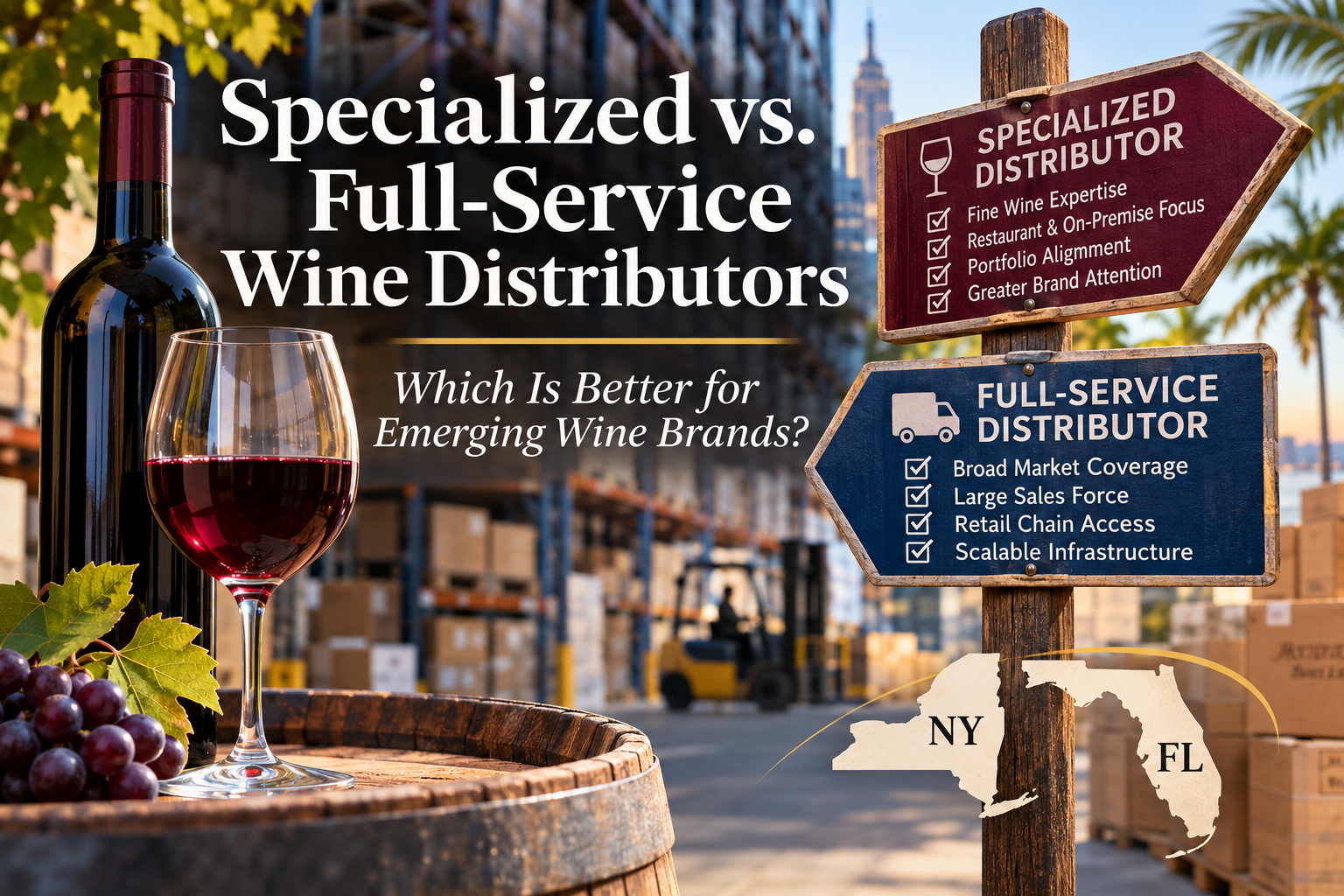
In today's increasingly competitive wine industry, finding a distributor is challenging. Finding the right distributor can be even harder.
For emerging wineries and international wine producers entering the United States, the decision often comes down to two options: partnering with a large, full-service beverage distributor or selecting a smaller, specialized wine wholesaler.
A recent announcement from Wilson Daniels Wholesale provides an interesting perspective on this increasingly important decision.
Wilson Daniels Wholesale Rebrands as WDW
On November 2, 2026, Wilson Daniels Wholesale announced its rebranding as WDW, reinforcing its commitment to fine wine distribution at a time when many competitors are expanding into spirits, beer, and ready-to-drink (RTD) beverages.
The company currently operates wholesale businesses in New York, New Jersey, Connecticut, Oregon, and Washington.
According to Shanken News Daily, WDW represents nearly 800 winery partners and projects approximately $110 million in annual revenue for 2026, with sales volume of approximately 490,000 cases.
Perhaps most interesting is the company's emphasis on the on-premise market.
Approximately 54% of WDW's wholesale business comes from restaurants, hotels, and other on-premise accounts.
While much of the beverage distribution industry continues moving toward larger, diversified portfolios, WDW is emphasizing its specialized fine wine expertise.
This raises an important question for emerging wineries: Is bigger always better when choosing a distributor?
The Challenge of Getting Attention in a Crowded Distributor Portfolio
Large beverage distributors offer several potential advantages, including established logistics networks, broad geographic coverage, extensive retail relationships, and substantial sales organizations.
For established brands generating significant volume, these capabilities can be extremely valuable.
However, emerging wine brands face a different set of challenges.
A distributor may represent hundreds or even thousands of competing products. Sales representatives have limited time and often prioritize brands that already generate meaningful revenue.
For a smaller winery, simply being included in a distributor's portfolio does not guarantee that sales representatives will actively introduce the wine to retailers or restaurants.
Without consistent market attention, even exceptional wines can struggle to develop meaningful sales.
The Advantages of Specialized Wine Distributors
Specialized distributors typically concentrate on a particular category, price range, or customer base.
A fine wine wholesaler may employ sales representatives with extensive knowledge of wine regions, grape varieties, vintages, and food pairings.
These relationships can be particularly valuable when approaching restaurant wine directors, sommeliers, independent wine retailers, and hospitality buyers.
For an emerging premium winery, a specialized distributor may offer several advantages:
- Sales representatives who understand how to present and sell premium wines.
- Established relationships with restaurants and independent wine retailers.
- Greater alignment between the winery's positioning and the distributor's existing portfolio.
- More focused brand education and promotional opportunities.
- A sales approach built around developing long-term customer relationships.
However, specialization alone does not guarantee success.
A distributor's portfolio size, sales resources, geographic coverage, and willingness to prioritize a new brand must still be carefully evaluated.
When a Full-Service Distributor Makes Sense
Large, diversified distributors can be excellent partners for wineries with established consumer demand, competitive pricing, and sufficient production capacity.
Their infrastructure may be particularly valuable for brands targeting regional retail chains, major accounts, or broad geographic distribution.
A full-service distributor may provide access to sophisticated inventory systems, established delivery networks, and extensive sales coverage.
The key is determining whether the distributor's capabilities match the brand's current stage of development.
A winery producing a few thousand cases annually may have very different needs from one producing several hundred thousand cases.
The right distribution partner isn't necessarily the largest company. It's the company best equipped and motivated to develop your brand.
Why On-Premise Relationships Matter
One of the most revealing details in the WDW announcement is the importance of its on-premise business.
Restaurants, hotels, private clubs, and other hospitality accounts can play an important role in introducing consumers to unfamiliar wines.
A recommendation from a knowledgeable sommelier or wine director can help establish credibility and encourage consumers to explore a new producer.
For premium and boutique wineries, these relationships may be particularly valuable.
However, securing an initial restaurant placement is only the beginning.
Successful on-premise development requires consistent account visits, staff education, wine tastings, menu placements, and ongoing follow-up.
Most importantly, brands need to generate reorders.
A wine that appears on a restaurant's list but rarely sells does little to establish sustainable distribution.
Five Questions Every Winery Should Ask Before Choosing a Distributor
1. How many competing wines are already in the portfolio?
Understanding the distributor's existing brands helps determine where your wine fits and how much competition it may face for sales attention.
2. Which accounts does the distributor actively service?
A premium winery targeting restaurants and independent retailers needs a distributor with strong relationships in those channels.
3. Who will be responsible for developing the brand?
Ask whether the distributor has dedicated sales representatives, brand managers, or other personnel responsible for supporting emerging products.
4. What marketing and sales support will be provided?
Clarify expectations regarding tastings, sales meetings, promotional programs, account visits, and retailer education.
5. How will performance be measured?
Initial placements are important, but depletion reports, account activity, inventory levels, and reorders provide a more meaningful picture of long-term performance.
These questions should be addressed before entering into a distribution agreement.
Why Local Market Development Still Matters
Whether a winery selects a specialized wholesaler or a large full-service distributor, consistent market development remains essential.
This is particularly true in competitive markets such as metropolitan New York and South Florida.
Independent wine retailers, restaurants, hotels, private clubs, and specialty accounts often require individual attention and established buyer relationships.
Emerging brands may not have the resources to employ full-time regional salespeople in every market.
Working with an experienced market-development partner can help bridge that gap.
Dedicated local representation can support distributor relationships, identify target accounts, introduce products to buyers, coordinate tastings, monitor sales activity, and encourage repeat orders.
This approach helps ensure that obtaining distribution becomes the beginning of a sales strategy rather than its conclusion.
Helping Emerging Wine Brands Break Out
At Breakout Brand Group, we understand the challenges emerging wineries and international wine producers face when entering competitive U.S. markets.
With more than 30 years of sales and marketing experience, including extensive experience in the wine and spirits industry, we help beverage brands navigate distribution and develop sustainable sales opportunities.
Our services include:
- Distributor research, identification, and selection.
- Market-entry strategy for New York and Florida.
- Retail and on-premise account development.
- Buyer relationship development.
- Tastings, promotional events, and brand activations.
- Sales tracking, account follow-up, and reorder development.
- Ongoing distributor and market support.
We believe that promising brands deserve more than simply being added to a distributor's portfolio.
They deserve a strategy designed to build awareness, establish relationships, and generate sustainable sales.
Finding a distributor is an important first step. Finding the right distributor—and supporting that relationship with consistent sales execution—is what helps a brand break out.
Looking to introduce or expand your wine brand in New York or Florida? Visit Breakout Brand Group to learn how we can help.
Industry source: Shanken News Daily, November 2, 2026 — Wilson Daniels Wholesale Rebrands as WDW, Emphasizing Fine Wine Focus.
Original market-development analysis by Breakout Brand Group.